Unfocused
Summary
BlacKkKlansman has a great premise, but the story’s lack of focus makes it less enjoyable than it should be.
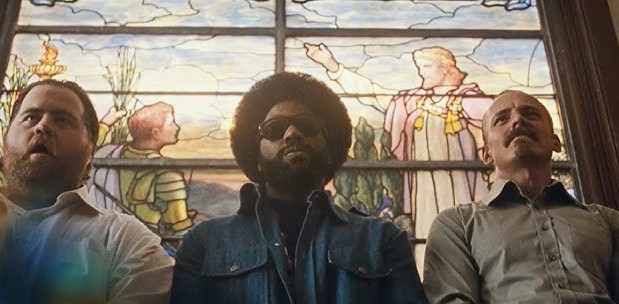
Plot: Undercover detective Ron Stallworth (John David Washington) covertly joins the Ku Klux Klan, with fellow detective Flip Zimmerman (Adam Driver) representing him in person when dealing with the organization.
Review: I know that Spike Lee’s movies aren’t meant for me. Lee is an undeniably talented director; visually, he is terrific, and his soundtracks are always memorable. However, aside from Inside Man, it seems that his movies (at least the ones I’ve watched) deal primarily with racial injustice. Now, I agree, there is racial injustice in the world. Always has been, and sadly, probably always will be. That doesn’t make it right, and if Mr. Lee wants to dwell on this social topic for his entire working career, so be it.
So, why am I watching it? Well, the premise intrigued me – a black man joining the Ku Klux Klan? This, I had to see. Plus, my late father had the 4K in his movie collection, and if he found something to enjoy in the movie, why couldn’t I? Not every Spike Lee joint has to be inaccessible, does it?
Well, the movie does have great performances. John David Washington is a force in the lead role (proving the apple doesn’t fall far from the tree), and this is the best I’ve seen Adam Driver at. Plus, Steve Buscemi’s brother is in the movie! I didn’t know Steve Buscemi even had a brother! All of the Klan are terrific and totally believable in their roles – I think, like Adam Driver, this is the best I’ve seen Topher Grace at. Not a smartass smirk in sight. So, if you’re just a fan of exceptional acting and don’t care about anything else, you should check this movie out.
As for the story – the parts of tension with the cops trying to infiltrate the Klan are the best scenes in the movie. The protagonists walk a tightrope of being found out by the more paranoid members of the group, and it seems like Driver’s character especially is always in danger. There’s also a very tense scene in which the threat of violence plays out masterfully, thanks to Lee’s aforementioned skills as a director. The soundtrack, as with all of Lee’s movies, is terrific and beautifully works with what you’re seeing onscreen.
That’s the good stuff. Unfortunately, the movie is incredibly unfocused. There’s a whole subplot in which Washington’s character dates the head of the local black empowerment group. The sequences with the two of them drag, mostly because the female character, Patrice, is so unlikeable. She reminds me of every “Smarter than you” university student I’ve ever come across, and even though I don’t wish any harm to come to her character, she comes across as incredibly arrogant and lacking self-realization. Every time I saw her on screen, I groaned.
There’s also the end – which leaves the 1972 era of the main story and delves into 2017 footage of racial speeches, demonstrations, fights, etc. If the intention is to show that there are still racial tensions 45 years after the events that unfolded in the previous two hours, that is a given – as I said off the top, unfortunately, this will probably always exist. Where it didn’t belong, though, is in this movie. At 135 minutes, the narrative is already lengthy, and adding this part does not feel like a powerful statement to me but rather a painfully obvious rehash of what I already know.
So, BlacKkKlansman is a good movie, but not a great one, and not one I’ll feel the need to revisit. While I appreciate the sentiment, the premise, and the acting, the story too often veers into political conjecture (such as Harry Belafonte’s laboured account of a horrific lynching he witnessed) and doesn’t focus enough on the great story within the movie. If Spike Lee had concentrated more on using his considerable gifts to craft a truly great narrative without needing to stand on the same tired soapbox as network news, this would have been a film that stood the test of time.