Verdict
Summary
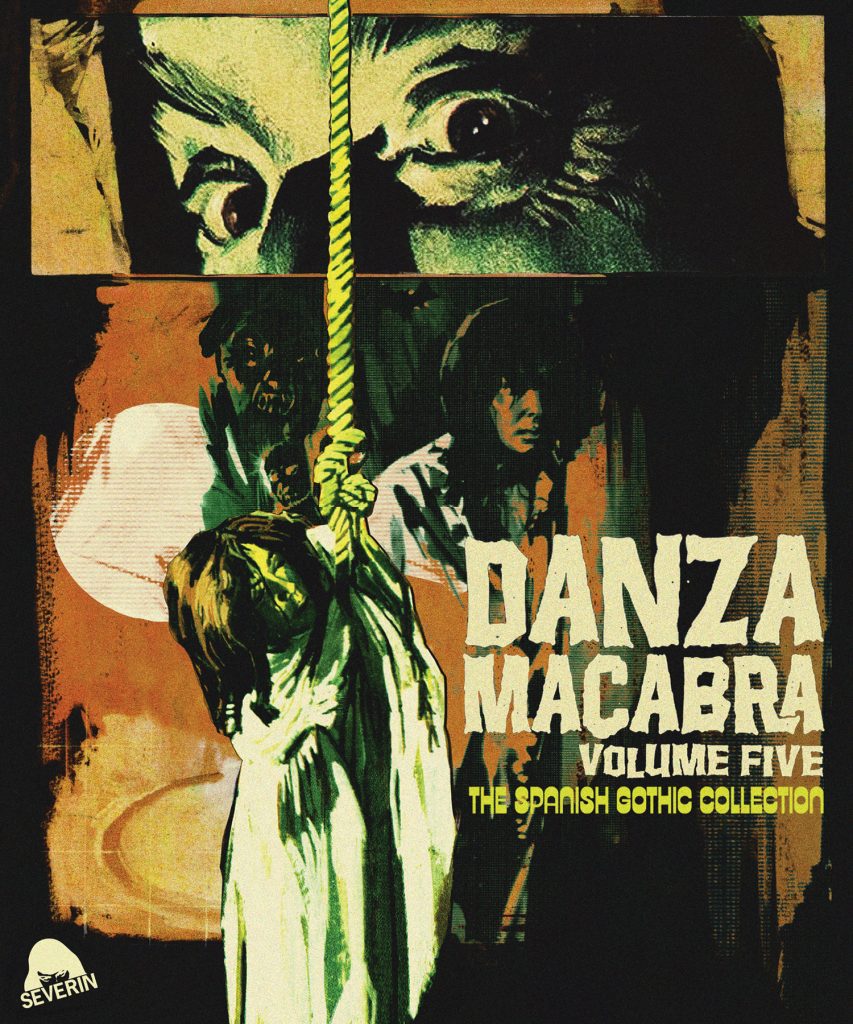
Severin’s new four-film collection Danza Macabra Volume 5 is given the royal treatment with superior high definition transfers, with commentaries, documentaries, alternate versions, and a strong hardback box sleeve that compliments the films, fitting nicely alongside the previous four sets in this collection. Fans of Spanish gothic horror will most likely need to add this one to their shelves, and rightly so.
Strange Voyage (1964) Plot:
Two childlike siblings are faced with a big deception in a very small village in Spain when their overbearing and abusive older sister is killed in secret in their house.
Review:
In a small village in Spain where everyone knows everyone else’s business, life is very simple: At night, everyone goes to the cantina and dances and carouses to live music, smoking, drinking, and hooking up with the same people. On Sundays, everyone goes to church. The town has one smoking hot young woman – Angelines (Sara Lezana, who was not even 16 when she made this) – and all the men want her, but she looks down on all the locals and sets her sights on leaving town some day with a man who can provide for her. The town has one family – the Vidals – whose mansion overlooks the village square, and the matriarch is the spiteful and resentful old maid Ignacia (Tota Alba), who despises her life and the fact that she’s tied to her younger siblings, the fully grown childlike twits Paquita (Rafaela Aparicio) and Vernacio (Jess Franco), both of whom are like anchors tying her in place. When Ignacia begins secretly seeing the town musician, a handsome young man named Fernando (Carlos Larranga), she sells the Vidal farms for a great deal of money so that she can impress Fernando (who is dating Angelines and another local woman) and coerce him into taking her on a world tour … but without her dimwit siblings, whom she plans to murder in secret. Fernando hates Ignacia, but loves her money, and when Ignacia is about to execute her plan, her two younger siblings turn the tables on her in a moment of self-defense and kill her, leaving a body on the floor, not having the intelligence to know what to do with it. Fernando steps in and helps them dispose of the body, and he assumes the dead woman’s identity in a carefully planned and executed scheme where the entire village – including the other women in his life – has no idea that she’s dead for a few days, which is all the time the three of them need to set the stage for the next steps of their foolhardy plan … which doesn’t go off without a hitch.
A slow burn gothic mystery that lays out all the lurid stuff in flashback in the final act of the film, Strange Voyage has some vivid details of the village and all its eccentric characters, setting up more characters than it needs to in order for the plot to be fleshed out. It might’ve been a bit more tight in its execution and mystery, but by the end it sort of feels watery and sad. Director Fernando Fernan Gomez showed promise as a filmmaker, but the film doesn’t really have a rewatchable factor.
The Turn of the Screw (1985) Plot:
An ex-priest takes a job teaching two wealthy orphans and finds that their home and estate are haunted.
Review:
Roberto (Pedro Mari Sanchez) is a handsome young man who leaves the Catholic church for a lack of faith, but he takes with him years of experience of discipline. He is hired by the wealthy uncle of two orphan children – 11 year-old Flora (Cristina Goyanes) and 15 year-old Mikel (Asier Hernandez) – who live on a vast, oceanfront estate occupied only by a middle-aged maid who can’t read. When Roberto arrives, he is given full authority over the house and over the children, and he takes command in a stern and smug, self-assured fashion, dictating rules as he sees fit. He finds himself strangely attracted to both children, but in a cautious, sober way: Flora is beautiful and not yet in her bloom as a prepubescent, and he is more attracted to her angelic, cherub ways than in her body, but in Mikel he finds a more mature case study that challenges his authority and his possible inclinations with homosexuality. Speaking of Mikel, Roberto almost fears the boy and his level of maturity, but he repulsed by the fact that the brother and sister still takes baths together and whisper constantly to each other, possibly concocting mischief. When Roberto begins seeing ghostly specters of the children’s mother, who committed suicide, as well as the spirit of the groundskeeper who met a grisly fate, Roberto’s very sanity is tested because the children swear that they can’t see what he sees. is the estate haunted … or is Roberto going insane?
An unusual gothic horror film with a very subtle undercurrent of repressed sexuality and a growing sense of unease, The Turn of the Screw, based on the Henry James novel, has some deliberately calculated performances, with two strangely behaving child characters who seem to know more than they let on, leading to an ending that may divide viewers. Director Eloy De La Iglesia was very good at this sort of material, and he delivered an uncharacteristically uncomfortable horror film here.
Exorcism’s Daughter (1971) Plot:
An insane asylum for women is overrun with debauchery and confusion when a respected doctor comes to inspect … and do actual work with these deranged women.
Review:
In an indeterminate time, a remote insane asylum for women has gone mostly unnoticed for years, completely reliant on a single warden, an uneducated louse of a man (played by Francisco Rabal) who has taken advantage of the situation by using the asylum for his personal harem should he choose. The inmates are indeed insane: They can hardly care for themselves, much less keep themselves safe, and the few nurses on staff turn a blind eye to the warden’s methods. Women are known to die of starvation or infections under his care, and when a real doctor (played by Espartaco Santoni) shows up at the door, demanding to be given a tour of the asylum, the warden realizes that the jog is likely up now that the medical board has sent this doctor to clean the place up and actually tend to these poor women. As the doc tours the place, he’s shocked at the deplorable conditions, and one inmate in particular captures his attention: a young woman Tania (Analia Gade) who is nearly in a state of catatonia, but clearly has intelligence. Over the course of some weeks, the doc coaxes her story out of her, and unearths a horrible childhood trauma involving an exorcism, and the revelation will change his life, as he tries to bring her to a state of healing … which will likely be impossible in the awful place that is governed by chaos and madness.
Released in two versions – a 111 Spanish version (which is the one I watched) and a shorter 96 minute version that came out in the U.S. as The House of Insane Women – Exorcism’s Daughter is a consistently unnerving film that never ceases its unrelenting depiction of insanity and depravity in a women’s insane asylum. With nonstop screeching, screaming, food fights, and a general sense of anarchy, the movie isn’t what I’d consider to be a “horror” film in the traditional sense, although it goes there, but instead it’s more of a Cuckoo’s Nest type of movie, but there’s really no release. It just keeps going within the walls of the asylum and never stops. It’s no fun, really, but it does have the sense of a gothic horror movie with a weird underlying supernatural element that reveals itself in flashbacks, so if you’re a fan of those, then perhaps this will strike you right. Rafael Moreno Alba directed.
The Dracula Saga (1973) Plot:
Dracula’s pregnant granddaughter and her husband are summoned to his estate for nefarious purposes.
Review:
Count Dracula (Narciso Ibanez Menta) summons his last living relative, his granddaughter Berta (Tina Sainz), who is nearly nine months pregnant, along with her husband Hans (Tony Isbert), to his estate that has a sprawling castle on it. They brave the travels, finally being deposited nearby when the horse-drawn cart refuses to advance, and when they are welcomed by three beautiful women (who are suspiciously pale) who live with the count, Berta and Hans are given room and board and treated well, although the wine set at the table isn’t wine, but a thick red sludge. When the Count eventually makes his appearance, he makes it very clear that he wants Berta to have her son (which he is certain she’ll have) within the walls of his castle because the boy will be the last of his line to be born. Dracula’s wives seduce Hans and turn him into a slave (surprise! They’re all vampires, if you couldn’t guess), and Berta finds herself merely a pawn in Dracula’s scheme. When she realizes too late that Dracula doesn’t have her – or her unborn son’s – best interests at heart, she makes a final stand against the bloodsuckers.
Appropriately gothic and sexy (and bloody too), Leon Klimovsky’s The Dracula Saga is everything fans of Dracula movies would want with all the gooey red blood, beheadings, lots of nudity, and a creepy ending where Dracula’s severed head cackles as his grandson takes his first sip of his blood. The best film in this particular collection, this one rises from the grave in victory.
Severin’s new four-film collection Danza Macabra Volume 5 is given the royal treatment with superior high definition transfers, with commentaries, documentaries, alternate versions, and a strong hardback box sleeve that compliments the films, fitting nicely alongside the previous four sets in this collection. Fans of Spanish gothic horror will most likely need to add this one to their shelves, and rightly so.
Bonus Materials
- Audio Commentary For STRANGE VOYAGE With Dr. Adrian Smith, Co-Author Of Norman J. Warren: Gentleman Of Terror
- A ‘Rara Avis’ Duo – Ángel Sala, Head Of Programming At The Sitges Film Festival, On Fernando Fernán Gómez & Jess Franco
- The Multifaceted Mind Of Fernando Fernán Gómez – Filmmaker Helena de Llanos On The Work And Legacy Of Her Grandfather
- Facing The Sun: STRANGE VOYAGE’s Promise Of Broken Dreams – Video Essay By Andy Marshall-Roberts, Host Of The Nasty Pasty Podcast
- STRANGE VOYAGE Trailer
- Audio Commentary For THE DRACULA SAGA With Rod Barnett And Troy Guinn, Film Historians/Co-Hosts Of NaschyCast
- Klimovsky’s Vampires – An Appreciation By Ángel Sala, Head Of Programming At The Sitges Film Festival
- The Spanish Hammer: The Rise And Fall Of Profilmes – Interview With Profilmes Production And Sales Executive Lluís Ferrando
- Inheritance As Horror: Blood, Tradition And The Gothic In THE DRACULA SAGA – Video Essay By Kat Ellinger, Author Of Daughters Of Darkness
- THE DRACULA SAGA Trailer
- Audio Commentary For EXORCISM’S DAUGHTER (U.S. Version) With Matt Rogerson, Author Of The Vatican Versus Horror Movies And Fulci’s Inferno: Faith In The Films Of A Horror And Giallo Auteur
- A Film That Stands Apart – An Appreciation By Ángel Sala, Head Of Programming At The Sitges Film Festival
- Madwoman In The Attic: EXORCISM’S DAUGHTER And The Female Gothic – Video Essay By Kat Ellinger, Author Of Daughters Of Darkness
- EXORCISM’S DAUGHTER Trailer
- Audio Commentary For THE TURN OF THE SCREW With Matt Rogerson, Author Of The Vatican Versus Horror Movies And Fulci’s Inferno: Faith In The Films Of A Horror And Giallo Auteur
- Repression And Tragedy – An Appreciation By Ángel Sala, Head Of Programming At The Sitges Film Festival
- One In Four Hundred – Interview With Actor Asier Hernández
- The Role Of My Dreams – Interview With Actress Cristina Goyanes
- Head Full Of Phantoms – Video Essay By Xavier Aldana Reyes, Author Of Spanish Gothic: National Identity, Collaboration And Cultural Adaptation
- THE TURN OF THE SCREW Trailer